
Bridging Vehicle Diagnostics with Agentic Software Systems
Overview
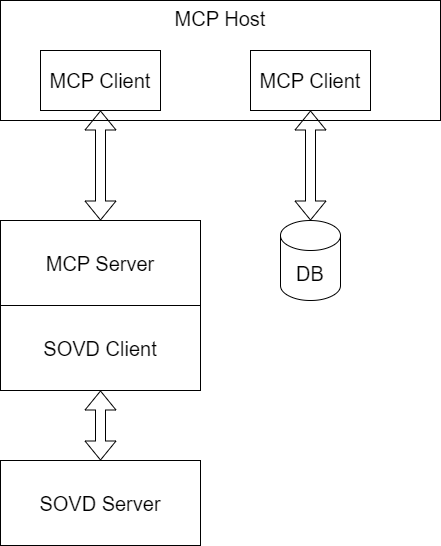
The SOVD/MCP Server is a gateway solution that connects Service-Oriented Vehicle Diagnostics (SOVD) with the Model Context Protocol (MCP), enabling vehicles to seamlessly integrate into modern, agent-based software ecosystems. It exposes vehicle diagnostic capabilities as discoverable, secure, and callable tools that can be consumed by cloud services, backend systems, and AI-driven agents.
This solution is designed for software-defined vehicle (SDV) architectures and supports both current and future automotive platforms.
The Solution
The SOVD/MCP Server acts as an intelligent middleware that:
Uses SOVD (ASAM standard) to model and execute vehicle diagnostics
Uses MCP to expose these capabilities as agent-consumable tools
Preserves full backward compatibility with UDS
Diagnostic services defined via DEXT are automatically mapped to MCP tools, enabling external agents to discover and invoke vehicle functions without ECU-specific knowledge.
Key Capabilities
Online Capability Discovery
Vehicle diagnostics are discoverable at runtime via MCP, reflecting the actual vehicle configuration and software state.Agent-Ready Interface
Vehicle functions are exposed as MCP tools, ready for AI, LLMs, and autonomous agents.Secure and Controlled Access
Authentication and authorization are enforced through MCP, mapped to SOVD diagnostic security levels.UDS Compatibility
Existing UDS-based diagnostics are reused as the execution backend.- SDV-Ready Architecture
Decouples diagnostics from hardware topology, supporting centralized and zonal vehicle architectures.
The SOVD/MCP Server provides a practical and standards-based path to integrate vehicles into modern agentic software environments. By combining ASAM SOVD with the MCP protocol, it enables a true software-defined diagnostic interface that connects vehicles with today’s state-of-the-art AI and cloud ecosystems.