
Validation Before Hardware Exists
Built on Unreal Engine, extended with experiment orchestration, AI perception training, and web-based scenario planning.
The Challenge
Modern drone systems combine flight control, AI perception, sensor fusion, and autonomous mission logic.
Yet development still relies heavily on limited real-world flight testing, expensive hardware iterations, non-reproducible edge cases, and manual parameter tuning.
Algorithms evolve faster than hardware.
Validation becomes the bottleneck.
The Solution
- A structured virtual development and validation platform that enables teams to:
- Develop and validate autonomy before hardware exists
- Train AI perception models using synthetic datasets
- Execute large-scale Monte Carlo simulations
- Version and reproduce experiments
- Define scenarios through a web-based mission planner
- This is not just simulation.
It is validation-driven drone system engineering.
Platform Overview
The platform connects scenario planning, experiment management, high-fidelity simulation, AI training, and evaluation into one integrated workflow.
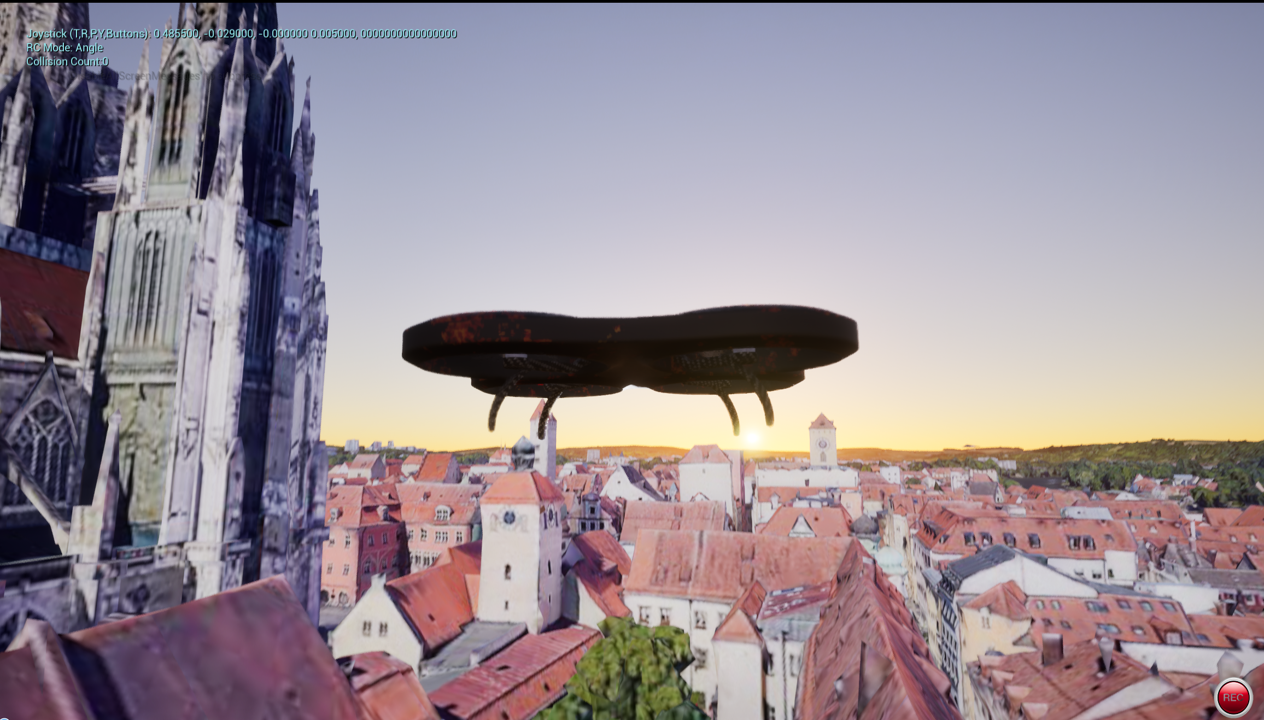
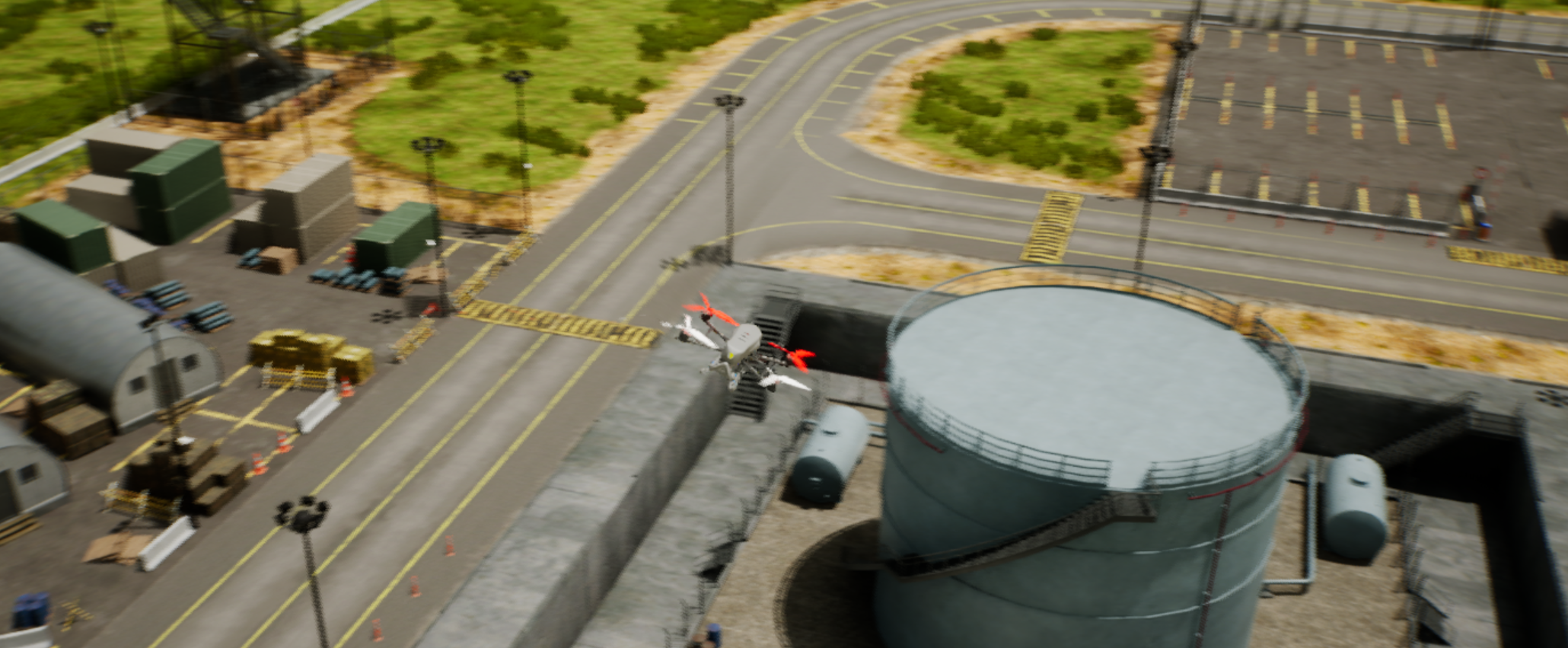
Photorealistic 3D environments powered by Unreal Engine combine with physics-accurate drone dynamics.
An experiment manager controls parameter distributions, scenario-aware execution, and reproducible test runs.
Development of the Swarm control systems
An AI perception stack enables automated dataset generation and structured CNN or SSD training pipelines.
A metrics engine evaluates detection accuracy, mission success rates, and failure patterns across thousands of controlled simulations.
Core Capabilities
High-Fidelity Simulation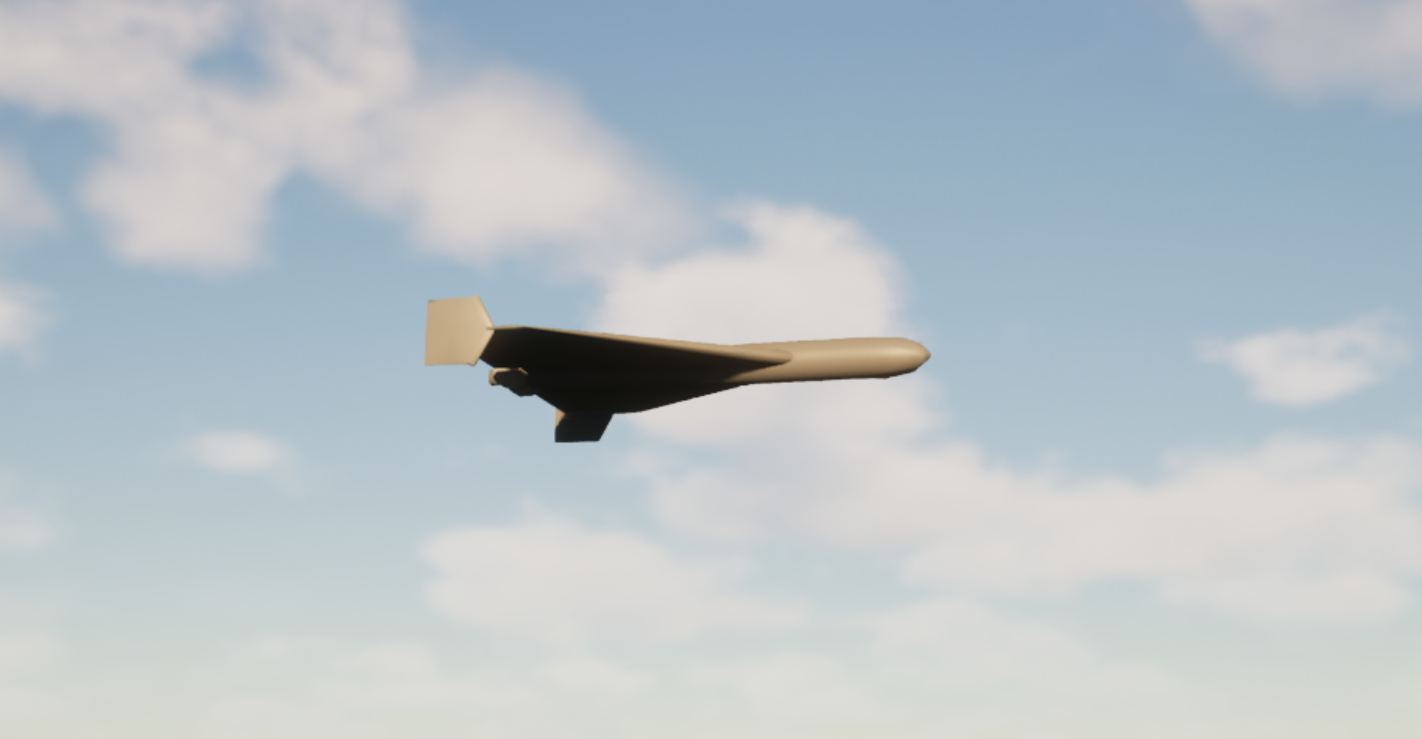
The platform delivers high-fidelity simulation using photorealistic environments and physics-accurate dynamics to replicate real flight conditions. Sensors, environment, and vehicle behavior are simulated consistently to support reliable testing and validation. Users can integrate their own drone models, enabling realistic evaluation of custom airframes, configurations, and control systems within the same simulation workflow.
Experiment Automation
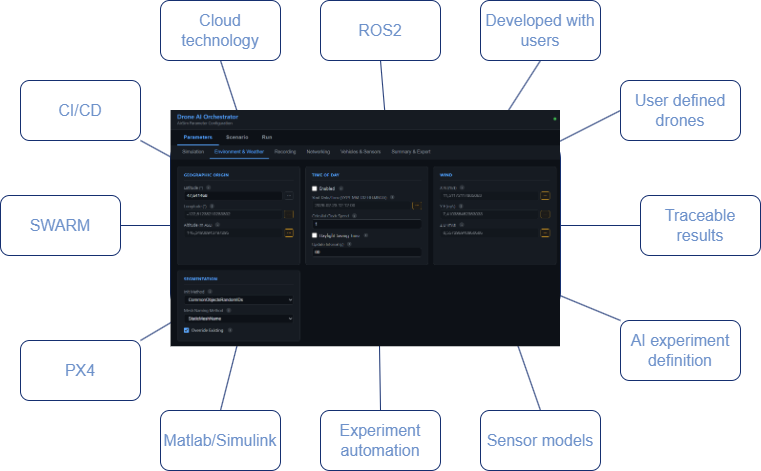
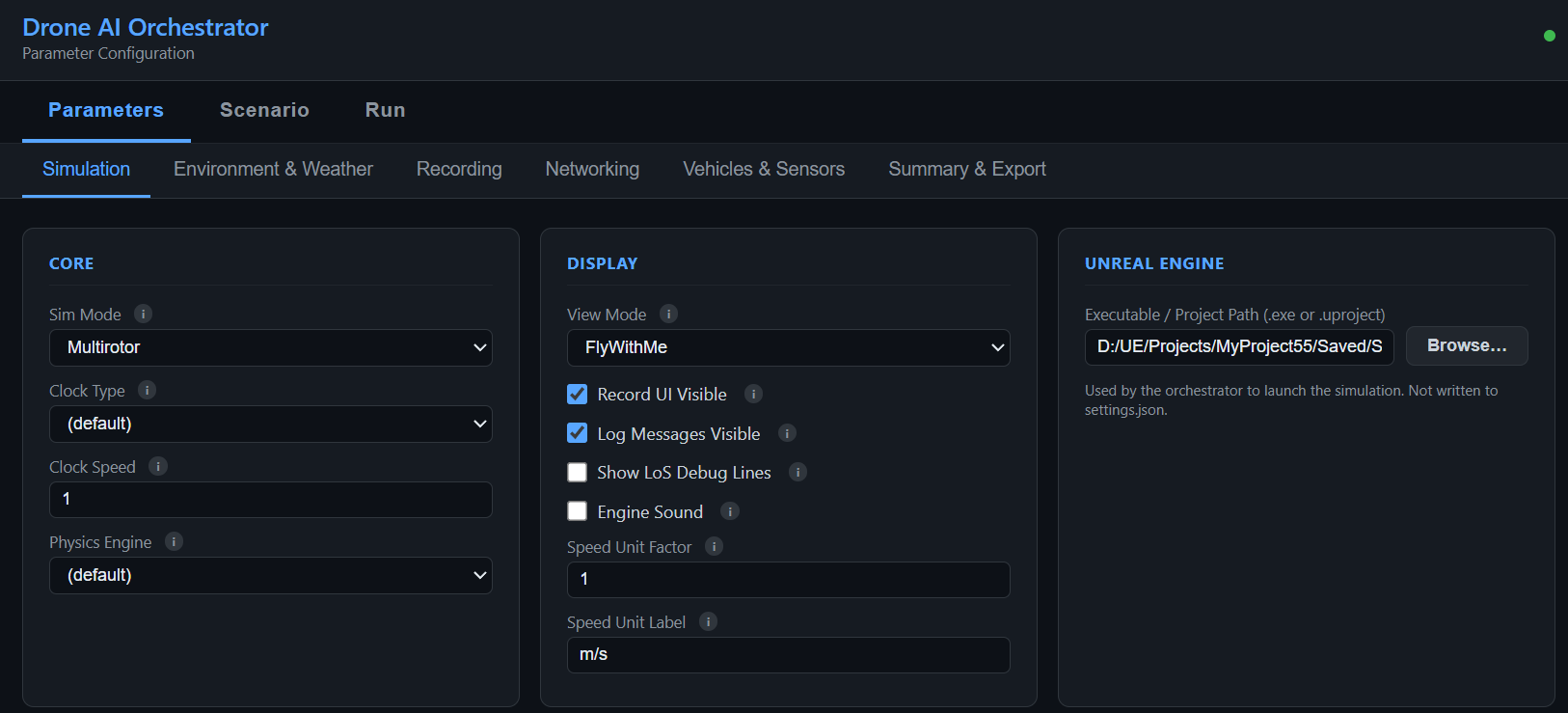 Distribution-driven parameter sampling, environmental randomization, sensor noise modeling, edge-case stress testing, and complete experiment version control.
Reproduce any test. Audit any result. Scale to thousands of runs.
Own Physical engine
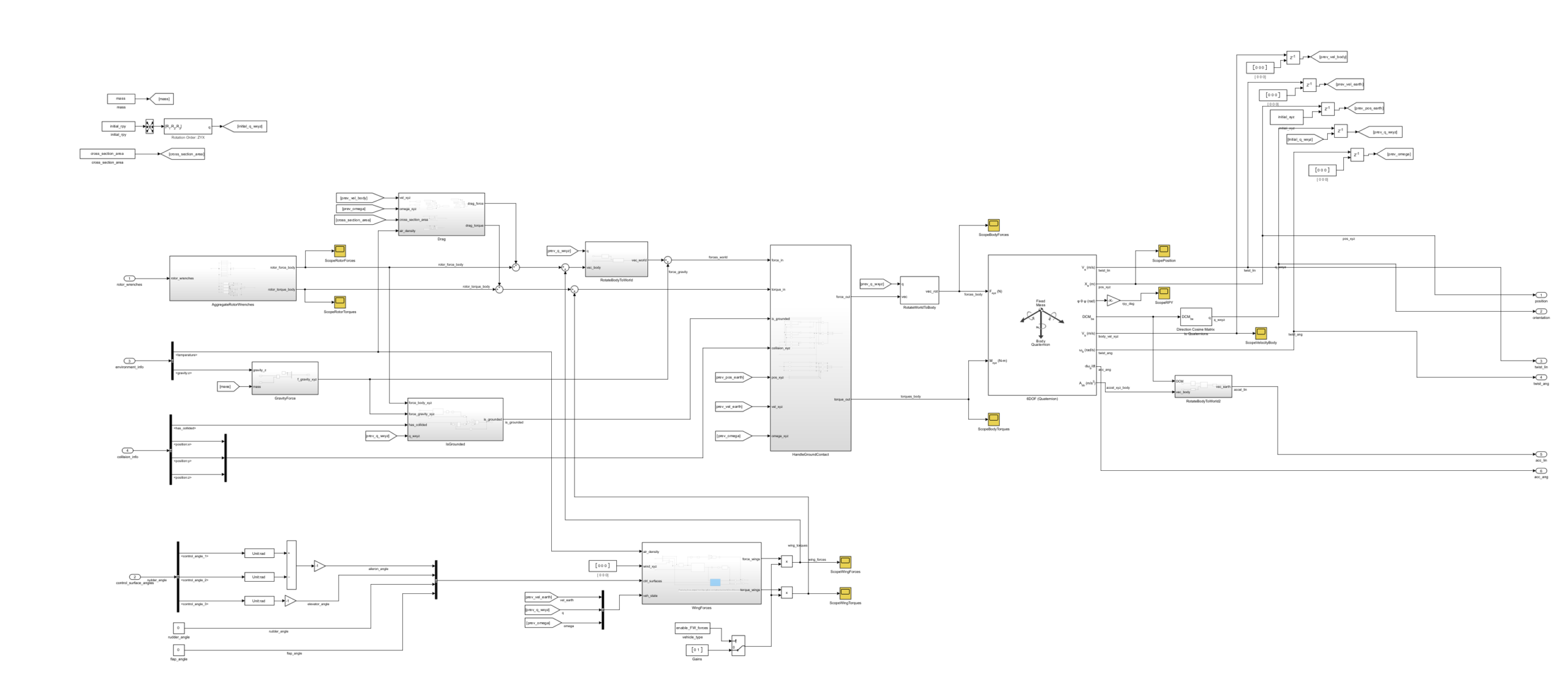 The platform allows full customization of drone flight physics with seamless integration into the simulation environment. Physical models can be implemented using native C++ code, generated through Embedded Coder or Simulink Coder, or connected via custom Simulink S-Functions. External physics engines run in synchronized real time with the simulation, ensuring deterministic behavior and consistent sensor interaction while enabling validation of proprietary dynamics and control models without changing the overall workflow.
SWARMs
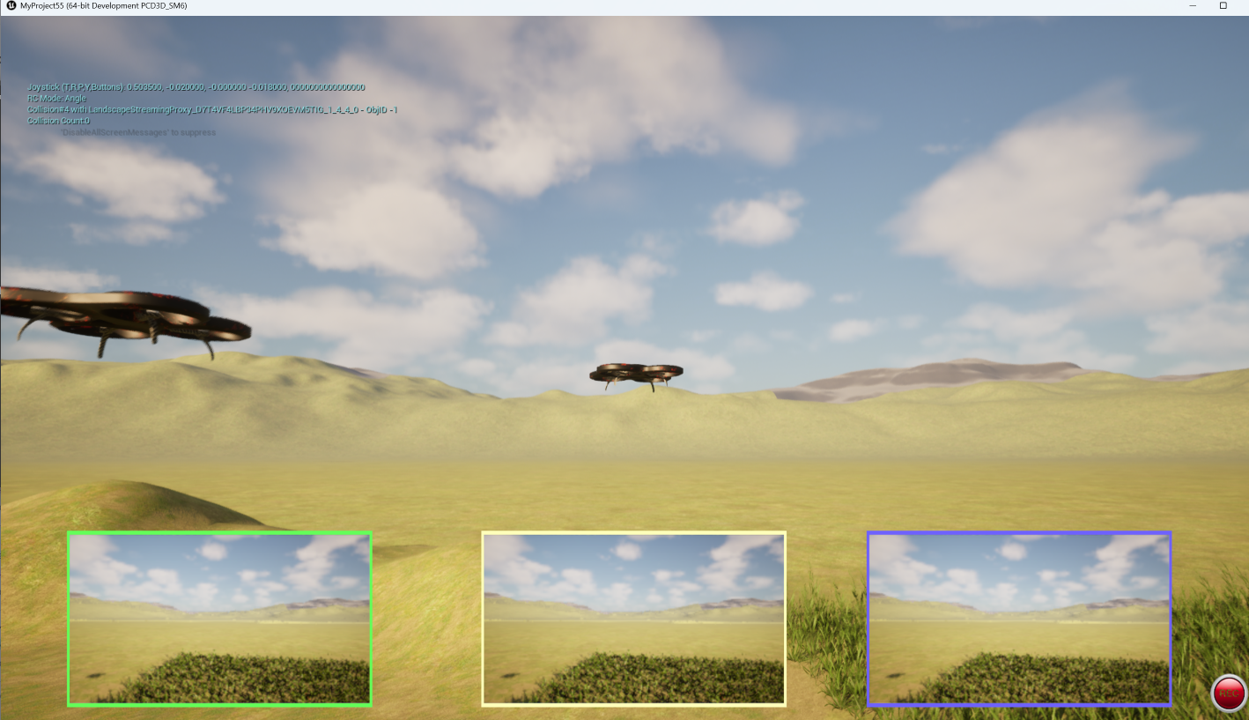 The platform enables configuration and simulation of multi-drone swarm scenarios within a shared virtual environment. Each drone can be controlled individually using a custom control system or operated through predefined missions and coordinated scenarios. This allows testing of cooperative behaviors, distributed autonomy, and swarm strategies under controlled and reproducible conditions.
Flexible and Secure Development
The simulation platform can be operated either in the cloud for scalable execution or deployed entirely on dedicated infrastructure. Organizations can run simulations on their own servers to keep sensitive data and proprietary models within their internal environment, avoiding the need to transfer information to third-party services while maintaining full functionality and control.
AI Perception Training
Synthetic data generation with automatic annotation export, domain randomization, dataset balancing, and GPU-ready training pipelines.
Integration into development toolchain
The platform integrates seamlessly with established development ecosystems such as ROS 2, PX4, and MATLAB/Simulink, enabling direct connection to existing control, simulation, and testing workflows. Open interfaces allow integration with additional tools and custom software stacks, ensuring that teams can continue using their proven development environments while extending them with high-fidelity virtual testing.
Use Cases
Autonomous navigation validation
AI object detection training
Edge case stress testing
Multi-drone coordination
Structured pre-certification development workflows
Why This Platform
Most teams use simulation tools.
This platform delivers structured validation engineering.
It provides experiment orchestration, parameter distribution management, scenario-driven automation, version-controlled validation, AI integration, and scalable execution architecture.
Simulation becomes a controlled, repeatable validation framework.
Built For
Drone OEMs, aerospace system integrators, defense contractors, robotics startups, AI perception teams, and research institutions requiring deterministic, scalable, and architecture-driven validation processes.
Bringing Validation Discipline to Drone Development
Move from hardware-dependent iteration
to structured, reproducible, and scalable virtual validation.
Start Validating Before You Fly
Request a technical demonstration or schedule an architecture consultation to explore integration into your development workflow.